Samuel Rhoads (d. 1784)
The Quaker Samuel Rhoads was one of the most influential master builders of the colonial period. Born in Philadelphia County, the son of John and Hannah (Willcox) Rhoads, he first appeared as a speculative builder flourishing in the 1730s and 1740s. Samuel also prospered in Philadelphia civic pursuits and became a leading member of the city’s early society. In 1741 he was elected to the Philadelphia Common Council, beginning a long period of public service. In 1745, Rhoads served on a committee to inspect and recommend repairs to the city’s fire engines. In 1751, he called for the Council to construct a bridge across the Schuylkill river at Market Street. Together with Powell, William Logan, John Stamper, and Benjamin Franklin, he advised the city on "the best means of improving the Swamp between Budds Buildings & Society Hill" in 1757/8.
His friendship with Franklin began about this time and would span over thirty years. Like the printer-statesman, Rhoads devoted increasing amounts of his time and wealth (derived largely from mercantile activity in later years) to charitable and educational works. Rhoads' relationship with Franklin and knowledge of machines led to his designation as the newly formed American Philosophical Society’s "mechaniacian," the organization's mechanical expert. He was a founding member of the Union Fire Company (1736), the American Philosophical Society (Vice-President, 1770-1776), a Director of the Library Company (1739-69, 1772-1774), a Manager of the Alms House, a founder and one of the twelve Managers of the Pennsylvania Hospital, an office he held for thirty years, as well as a founding Director of the Contributionship for the Insurance of Houses from Loss by Fire (1752-1763).
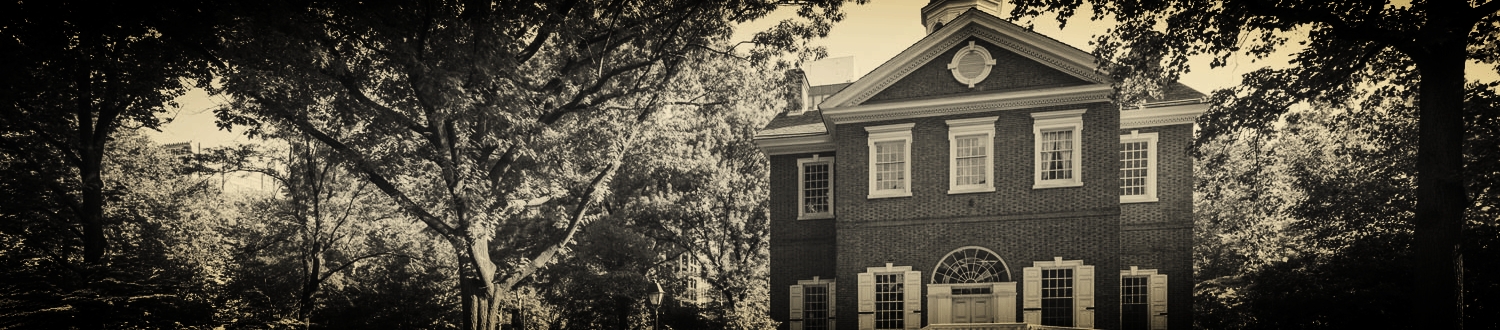
In 1761, Rhoads was elected to the Pennsylvania Assembly to represent Philadelphia City; he served until 1764 and lost reelection due to the ousting of the Quaker faction within the Assembly. During his tenure, he championed causes As tensions mounted between America and the Crown, Rhoads became politically more active; within a few months during 1774 he was Speaker of the Provincial Convention, a member of the First Continental Congress (meeting at Carpenters' Hall), and Mayor of Philadelphia.
Partially written by Roger W. Moss, Philadelphia Architects and Builders website.
Whitfield Jenks Bell, Patriot Improvers 1743-1768. Philadelphia: American Philosophical Society, 1997. 67-72.