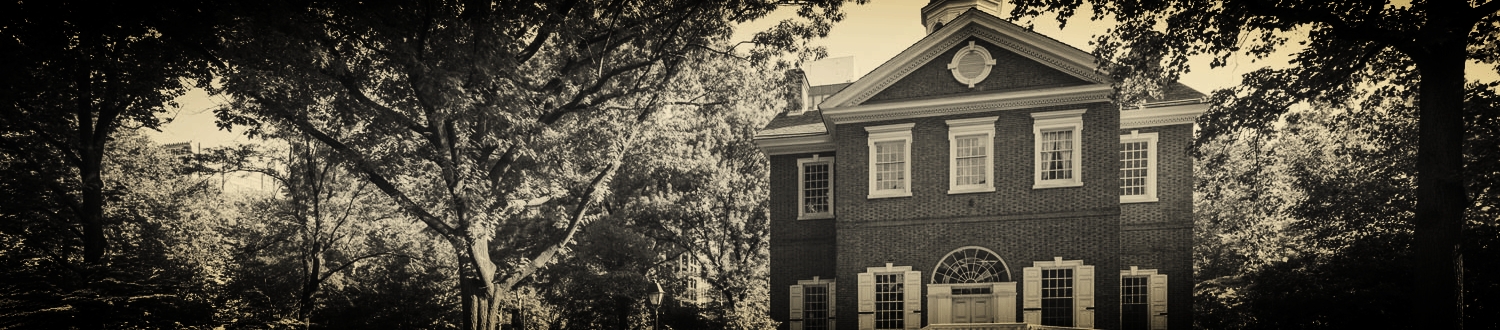
Bishop White House
Born in Philadelphia in 1748, William White graduated from the College of Philadelphia and was ordained as a deacon in England in 1770, and eventually consecrated as a bishop in 1787. White was the chaplain for the Continental Congress from 1777-1789 and afterwards the chaplain of the United States Senate. During and following the American Revolution, White wished to keep former-colonist Anglicans connected to the Anglican church in England and was elected president of the first General Convention of the Protestant Episcopal Church in 1785 and helped formulate a constitution creating the Episcopal Church in the United States of America.
The three story Bishop White House is a stately residence on Walnut Street between 3rd and 4th streets. It was built in the 1780s for the Episcopalian Bishop William White about half way between his two churches, Christ Church and St. Peter’s, where White was the rector for 57 years. The house still stands and is a spectacular of Philadelphian Georgian architecture with flemish bond brickwork, figured Keystone lintels above the sash windows, large and ornate dormers and a grand front entranceway. The house is notable in the history of domestic sanitation having one of the earliest known indoor privies. White’s neighbor to the west was the famous doctor Benjamin Rush from 1791-ca. 1794 at 83 Walnut Street (prior Rush had lived at 79 Walnut Street since 1780 with his medical office also on the property)
Richard Peters jr. was born at the family estate, Belmont Mansion overlooking the Schuylkill river in what is now Fairmount Park. His father, William Peters was a well-known judge and lawyer in colonial Philadelphia and his uncle and namesake, Richard Peters, was the rector of Christ Church and worked for the Penn family as Secretary of the Land Office, Secretary of the Province and member of the Governor’s Council. The elder Richard Peters was dedicated to the growth of Philadelphia and was heavily involved in the founding of University of Pennsylvania and also a director of the Library Company, a manager of the Pennsylvania Hospital and a member of the American Philosophical Society. Richard Peters jr. followed his father as a lawyer graduating from the College of Philadelphia (now University of Pennsylvania) in 1761. In 1776 Peters became the Secretary of the Continental Board of War. He also served as delegate to the Continental Congress from 1782-1783. Following the Revolution, he served as a Pennsylvania State Representative from 1787-1790 and as Speaker of the House from 1778-1790. Subsequently he was elected to the State Senate and served as its Speaker from 1791-1792. President Washington nominated Richard Peters to an open seat on US District Court for Pennsylvania in 1792.
While Belmont was his primary residence, much of Peters' work required him in the city and 307 Walnut was his urban residence. Located in an affluent neighborhood, Peters received the lot from his uncle following his death in 1776. Peters enlarged this house soon after purchasing the adjoining west lot in 1798 from William White. The completed 3 story house was one of the most elegant federal era homes in the city as evident by Peters’ tax rate being nearly double that of Bishop White’s already high valued home next door. A watercolor of the house, illustrated by David Kennedy shows a three-story four bay home with a modillion cornice, large sash windows and keystone lintels above. The entranceway was composed of a stucco cornice arch head and flat top frontispiece with reeded columns.