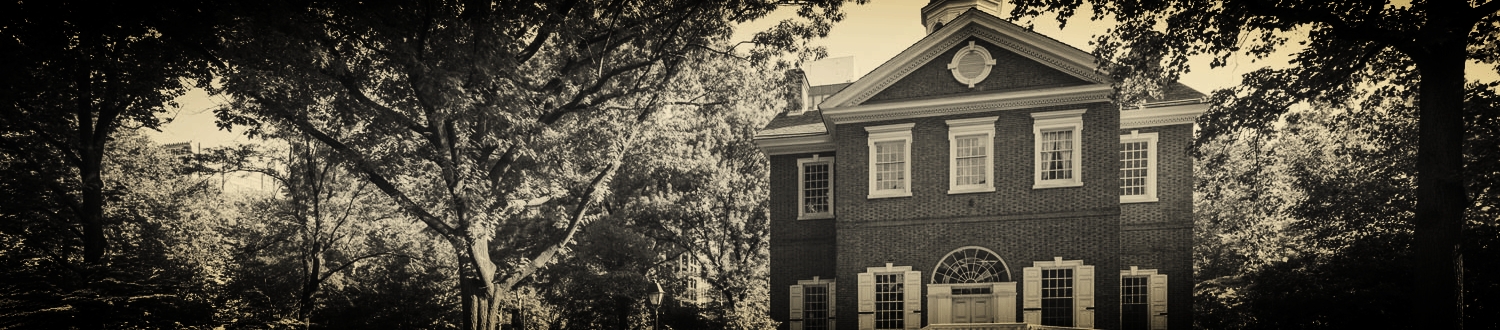
Clarke's Hall
William Clarke built this large dwelling at the South West corner of Chestnut and Third street around 1694 or slightly earlier. At this time, this area of Philadelphia was undeveloped and Clarke’s Hall was likely one of the first houses constructed west of Third street and one of seventeenth century Philadelphia’s most impressive homes. The two and half story brick structure had six bays on the first floor and second floor with entrance ways on each side facing both Chestnut Street to the north and Dock Creek to the south. A later owner, Israel Pemberton developed pleasure gardens stretching from the building all the way to Dock Creek. The many manicured plants and symmetrical walkways designed in formal English fashion were greatly admired by strolling Philadelphians making it one of the most elegant and talked about properties in the early days of Philadelphia.
William Clarke was a wealthy landowner who practiced law and served as a justice of the Supreme Court of the Lower Counties of Delaware and of the Provincial Supreme Court of Pennsylvania. Like many prominent Philadelphians, Clarke was a slave owner. James Logan, William Penn’s well known secretary, rented the mansion and gave rooms to Penn’s son William Penn Jr., a judge and former member of Parliament Roger Monpesson, and the controversial and rambunctious young governor John Evans. The Episcopalian governor was constantly at odds with the Quaker dominated assembly and his public antics caused a stir. Some of his antics include falsely raising the alarm about an approaching French fleet attempting to scare the Quakers into allowing the raising of troops in the colony and participating in riotous late night brawls in Philadelphia taverns aside Penn Jr., including beating a town constable sent to suppress the riots. Clarke's embarrassing actions led to his recall in 1709. Following William Clarke’s death, his family sold the mansion to the famous lawyer and attorney general Andrew Hamilton. Next, the mansion was sold to the successful Israel Pemberton, a successful merchant and leader of the Quaker faction in the colony’s representative assembly. Pemberton was known as ‘the King of the Quakers’.
From 1790 to 1800, Hall was occupied by Alexander Hamilton as offices of the United States Treasury. In 1809, it was the Farmers’ and Mechanics bank. Following the bank, the many rooms of Clarke’s Hall were rented out and was home to various stores and artisan tenants. During this time, Clarke’s Hall appearance was often changed to suit the various occupants. The sketch shows the large storefront windows evincing its use as a commercial building.