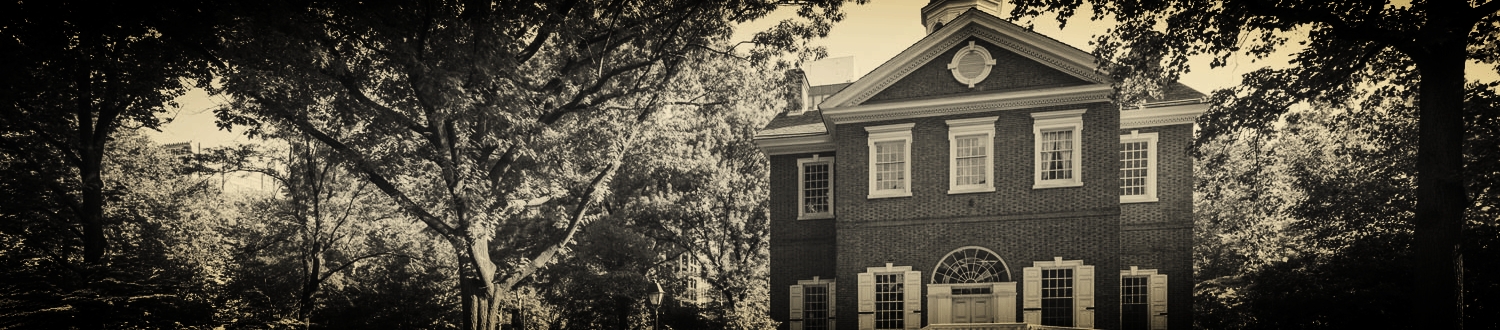
Pemberton House
In 1774, Joseph Pemberton built a stately three story brick residence on land he had bought from the Carpenters’ Company. Born in 1745, Joseph Pemberton belonged to one of the wealthiest Quaker families of colonial Philadelphia. His father, Israel Pemberton was a successful merchant and philanthropist funding Quaker schools, fire companies and the Pennsylvania Hospital. Israel’s election to the Pennsylvania Assembly and influence within the Quaker faction of the assembly led to his label as “king of the Quakers”. From 1746 until his death in 1779, Israel owned Clarke’s Hall and had established pleasure gardens behind the mansion. Consequently, his son Joseph grew up in the neighborhood and would have been familiar with the locale where he eventually built his house. Joseph Pemberton drifted from the austerity of his Quaker forebears and preferred finery in life. A portrait of a young Joseph at the Philadelphia Academy of the Fine Arts shows him dressed in lavish clothes and leaning on an elegant upholstered armchair. Similarly, his new house reflected the public promotion of his wealth with its glazed, flemish bond brickwork, brick arches with marble keystones, and elaborate frontispiece.
In 1767, Joseph married Anne Galloway, the daughter of the famous colonial era politician Joseph Galloway. The Galloway’s were wealthy landowners in Maryland and Joseph and his wife sold their newly built home in the late 1770s and spent most of their time living on their extensive Maryland lands. Not surprisingly for Philadelphians of his ilk, Joseph owned enslaved African Americans. The Pemberton house was eventually demolished in the 19th century. During the 1960s, the house was rebuilt during the extensive renovation and rebuilding projects of Independence National Historic Park. While the current, rebuilt structure is replicated in the 3-d model. The rebuilt Pemberton House is representative of the domestic architecture of the late colonial Philadelphia’s upper class. A nearby original example, the Powel House, bears many similarities.