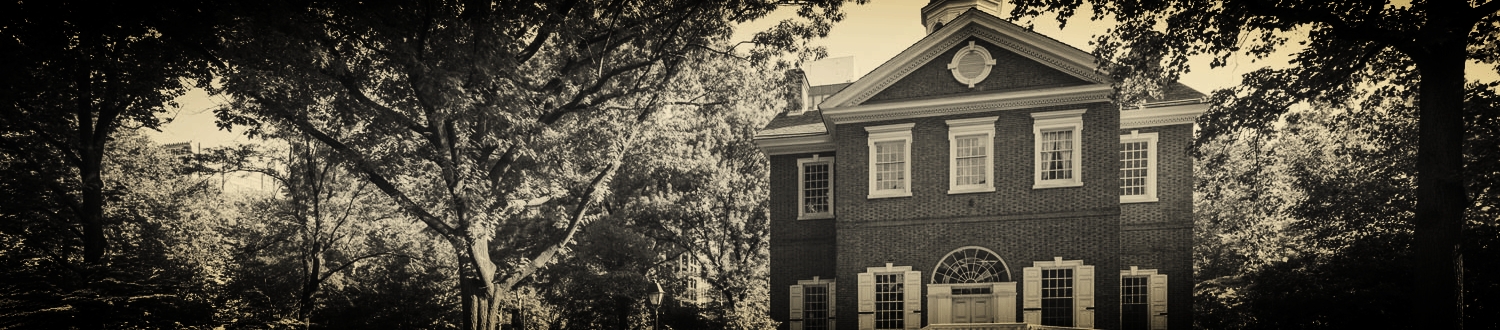
Carpenter's Hall and New Hall
Carpenters’ Hall, the home of the Carpenters’ Company of the City and County of Philadelphia, the oldest extant trade guild in North America, is one of the finest examples of Georgian architecture in Philadelphia. Designed by one of the Company’s most prominent master builders, Robert Smith, Carpenters’ Hall reminisces the architecture of the town halls’ of Smith’s native Scotland. The plan of Carpenters’ Hall also reflects Smith’s knowledge of 16th century Italian architect Andrea Palladio’s classically-inspired design and his influence on Georgian architecture. Carpenters’ Hall has a cruciform floor plan constructed with bricks in the popular Flemish Bond pattern complete with glazed headers. The first floor has 12 over 12 lite sash windows and the second floor front facade has large arched sash windows. Each of the four projecting sides capitalizes in triangular gables with modillion cornices and pent eaves. The central roof is capped with a large frame cupola and copper weathervane.
The Carpenters’ Company was founded in 1724 by a group of mainly Quaker master builders in Philadelphia taking influence from the ancient Worshipful Company of Carpenters of London. Taking influence from medieval guilds and the tenets of Quaker belief, they organized themselves to insure fair business practices among builders and assist each other in times of need. By the 1760s, the Company was well enough established to want a permanent home and a committee purchased the lot on Chestnut street in 1768. Construction began quickly but proved draining to the Company budget and was only continued by loans from wealthier members. In 1771, the Company had their first meeting inside the structure to inspect its progress and subsequently continued to meet there. Even with additional funding from members, the costly construction lagged and in 1773, the Library Company was allowed to rent space in the unfinished building to help pay for the continued work. The following year Carpenters’ Hall became the site of the First Continental Congress and for more than a decade, the American Revolution and its aftermath mostly halted construction. In 1790, the Company, eager to finish their Hall, built the main frontispiece and added the turned balusters below the arched windows. Soon after, they finished the building adding the fanlight over the main door and the rear frontispiece. While the interior of the Hall was changed during the 19th century, the outside appearance remains the same today as it was at the close of the 18th century.
Following its use as a hospital and supply house during the American Revolution, Carpenters’ Hall was re-ocuppied by the Carpenters’ Company, the Library Company and newly arrived tenants, the Philadelphia Society for Promoting Agriculture and the Secretary of War Henry Knox. Around 1790/1791 the newly established United States Bank requested use of most of the Hall and required renovations for the vault and other changes in the already crowded Carpenters’ Hall. While the Carpenters Company accepted the U.S. Bank’s rental agreement they did not wish to lose the Secretary of War and also realized they needed space of their own and for their other renters. Thus in 1791, the Company built in front of their original Hall a long, two-story, brick building along the North side of Carpenters’ Alley taking advantage of their sizable lot stretching back from Chestnut street.
New Hall was designed with more restraint than Carpenter’s Hall, which clearly remained the Company’s architectural showpiece. The two story building was built of brick with a drip course between the two floors and capped with a gently sloped hip roof. It displays typical late Georgian/early Federal elements such as flemish bond brickwork, dentil and molded cornice, and symmetrical windows and doorways. The first floor had four entrances facing Carpenters’ Alley leading into four separate rented spaces on the first floor while the second floor consisted of a single large room intended for use by the Carpenters’ Company. In 1833, the Company decided to add a third floor to New Hall to replace the failing original roof and provide a space for their newly established School for Architects. In 1861, a fourth story was added to New Hall. In the 1950s, the structure was deemed considerably altered from its original appearance, demolished and rebuilt to resemble its 1791 appearance.