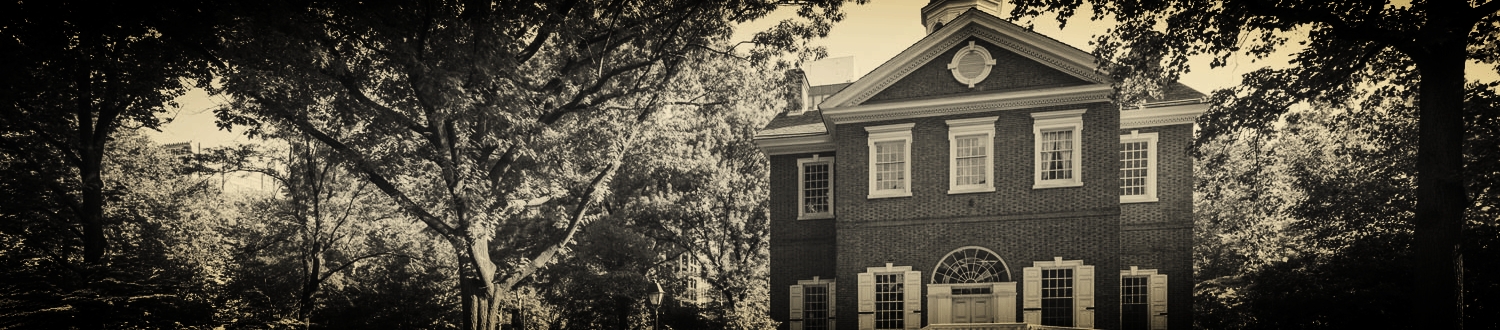
Fourth Street Friends Meetinghouse and School
Philadelphia, also known as the Quaker City, was founded in 1682 by the Quaker leader and visionary William Penn. Originally gatheringing in each others’ homes, Quakers in colonial Philadelphia built and worshiped in modest meetinghouses, architecturally similar to their own homes especially in comparison to the churches and homes of their Anglican neighbors. One of the many Quaker meeting houses in Philadelphia, the Fourth Street Friends’ Meeting was built in 1763. The brick meetinghouse was 76 feet long on Fourth street and 46 feet deep with two entrance ways on the long side facing Fourth street and gable roof on the shorter walls. This double entry and gable roof form was typical of mid-18th century Quaker architecture. Earlier Quaker meeting houses in Philadelphia tended to be more square in dimension and often had hipped or even gambrel roofs. It was built as a convenient location to serve young Quakers studying at the Friend’s school next door and as the home for Quarterly Youths’ Meeting.
The School building was located slightly south of the Meetinghouse further from the corner of Fourth and Chestnut streets. It was erected in 1744 and had a layout perpendicular to the later constructed meetinghouse with its shorter end facing Fourth street. Like the Great Meetinghouse built in 1699 and the Pine Street meetinghouse built in 1753, the Friends’ School had a shallow slanting hipped roof. The education of the city’s youth was of utmost importance to early Philadelphia Quakers and a school was established early on in Philadelphia’s history. The Friends’ School, eventually becoming known as the William Penn Charter School, was founded in 1689 at the request of William Penn and was originally located on Market street (then known as High street). Following the abandonment of the Fourth street building, the school moved to Eleventh street for the school year of 1841. The school on Fourth street became a mathematician school for a few years before being converted for commercial purposes and housing a gas fitting store. The structure was razed in 1859.