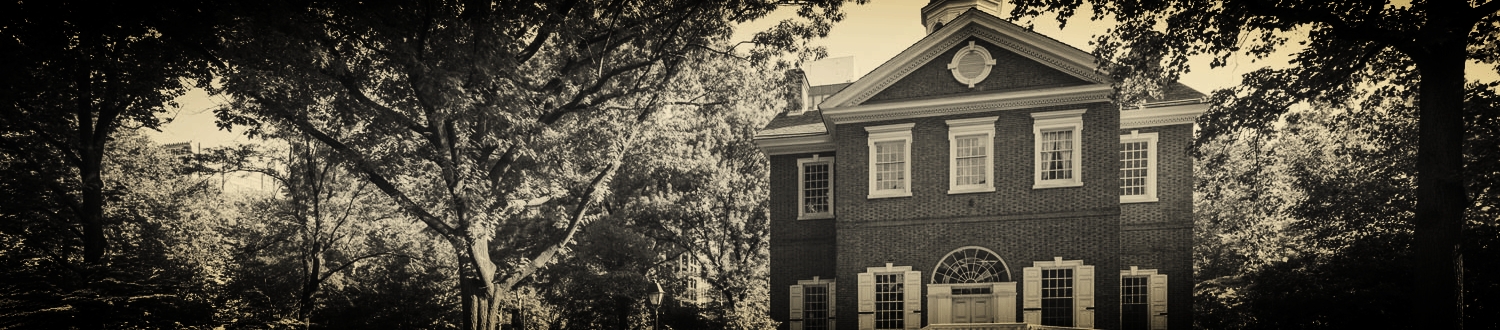
First Bank and Auditor's Office
Proposed by the first Secretary of the Treasury, Alexander Hamilton, the First Bank of the United States was a controversial centralization of the federal government’s financial assets under a national bank. First housed in nearby Carpenters’ Hall, the bank moved to its current location in 1797. After it was chartered in 1791, the First Bank worked to establish credit for the United States and repay the debts incurred during the Revolutionary War and its banknotes became the closest thing to a national currency during the Early Republic. Its supporters, championed by Alexander Hamilton, found fierce opposition from Thomas Jefferson and James Madison who felt that the institution was unconstitutional and a dangerous consolidation of power to the federal government that overwhelmingly benefited merchants and investors at the cost of the states and the general populace. While the bank was relatively successful at stemming inflation and the overextension of credit in the rapidly growing nation and also easing pressures of the financial and economic instabilities of the 1790s and early 1800s, Republicans continued to oppose the First Bank and their influence swayed the decision to not recharter the Bank in 1811. Following its dissolution, regulation of the local banks combined with debts from the War of 1812 caused a national financial depression. The building, as well as the Bank’s stock, was purchased by Stephen Girard and opened as Girard’s Bank in 1812.
Neoclassicism, the prominent architectural style in Western Europe drawing on Ancient Roman and Greek sources, reached its pinnacle in North America during the early years of the new United States of America, popularly known as the Federal period. The so-called Early Republic’s taste for classical influence symbolized a new beginning of democracy and prosperity reminiscent of the Roman and Athenanian Republics. The symbolic strength, order, and harmony of Federal neoclassicism is displayed at the First Bank by the symmetry of the pilasters and cut marble blocks on the front facade and accented with a triangular pediment supported by corinthian columns. Mercury, the Roman god of financial gain and commerce, is displayed prominently above the main entrance. This feature and other decorative elements, create a conspicuous symbolism of what the building represents: the financial independence and growth of the newly formed nation.
Directly north of the Bank on 3rd street was a house rented by the Auditor of the United States represented today by a brick foundation in the park. Further north, in Clarke’s Hall, was the office of the United States Treasury Department. During the 1790s Philadelphia was the capital of the United States and these two offices, conveniently located next to the First Bank, were important positions within the hierarchy of the Treasury Department headed by Secretary Alexander Hamilton and later Oliver Wolcott Jr. Due to the dynamic nature of the map, these structures are not represented as exact likenesses but would have either been repurposed buildings constructed in the second half of the 1700s during the development of the Pemberton gardens or newly constructed by the Treasury Department in the 1790s.